

Setting Up a Calm Home Office in a Corner
Start With the Space You Actually Have
A corner is often the most efficient spot in a UK home. Two walls give you built-in structure, you avoid stealing floor from the middle of a room, and the enclosed shape makes the area feel intentional rather than like a desk that has been abandoned in a passageway. Before you buy anything, spend ten minutes with a tape measure and a notepad.
Measure the usable length along both walls, from the corner outwards. Note anything that will interrupt a desk: skirting boards, radiators, plug sockets, a window reveal, the swing of a nearby door. A radiator under a desk is workable if you leave an air gap behind it, but a desk pressed against one will cook your legs and waste heat. Write down the height of your window sill too, in case you want the desk to sit beneath it.
Then decide what actually needs to live there. Most people only need room for a laptop or monitor, a keyboard and mouse, a notebook, and a mug. Everything else — the printer, the box of old cables, the stack of paperwork — belongs somewhere else. The goal is a workspace, not a storage unit with a chair.
Choose a Desk That Fits the Corner, Not the Other Way Round
A slim desk is the single biggest improvement you can make. Standard desks are often 60cm deep, which is generous for a full room but overwhelming in a corner. A depth of 40–45cm is plenty for a laptop and a notebook, and 50–55cm gives you comfortable room for a separate monitor and keyboard. Aim for a width between 90cm and 120cm, depending on your wall measurement.
- Wall-mounted or floating desks free up floor space underneath, which makes a small corner feel considerably less crowded.
- Corner or L-shaped units work well when both walls are at least 120cm, letting you spread out without blocking the room.
- Folding or drop-leaf designs suit rooms that double up as a dining or living space, provided you genuinely fold them at the end of the day.
- Adjustable-height frames are worth considering if you sit for long stretches — a slim top on a sit-stand base takes up no more footprint than a fixed one.
Check the seat height against the desk surface. You want your elbows at roughly 90 degrees and your forearms level or slightly angled down. If you are shorter or taller than average, a footrest or a cushion under you will do more for comfort than any expensive chair. Keep at least 60cm of clear floor behind the chair so you can push back without colliding with anything.
Layer Your Lighting
Harsh overhead lighting is the enemy of a calm corner. Aim for three layers instead: ambient light for the room, a task light for the desk, and something soft for the background.
For the task light, choose a warm white bulb in the 2700–3000K range. It is easier on the eyes in the evening and makes a small space feel settled rather than clinical. A clip-on or clamp lamp saves desk space entirely; an adjustable arm lets you throw light onto paperwork without glare bouncing off your screen. Position the lamp to the side of your writing hand so your own shadow does not fall across the page.
If the corner faces a window, resist the temptation to sit directly in front of it with a screen — you will spend the day squinting against the glare. Sit side-on to the window instead, so daylight falls across your desk. A simple roller blind or a light linen curtain softens the brightest hours without blocking the view entirely.
Get the Cables Under Control
Cables are what make a small workspace look chaotic, and they are the easiest thing to fix. Start by reducing the number of them: if you can charge your laptop by USB-C, you have just removed a power brick and a bulky lead.
Fix what remains to the underside of the desk. A shallow cable tray or a few adhesive clips will hold a power strip and the trailing leads out of sight. A short extension lead with a 2m flex is usually enough to reach the nearest socket without a tangle of adaptors. Bundle slack cable with hook-and-loop ties rather than plastic zip ties, so you can adjust them later without cutting anything.
- Route cables along the back edge of the desk and down one leg, never diagonally across the floor where you will trip on them.
- Label both ends of every lead with a small sticker or a wrap of masking tape — future you will be grateful.
- Leave a gentle loop of slack where a cable meets a plug or device, so nothing is strained when you move the desk.
- Keep chargers for phones and headphones in one small box in a drawer, not scattered across the surface.
Small Storage, Clear Surfaces
The rule for a compact desk is simple: if it does not earn its place on the surface, it lives elsewhere. A single pen pot, one notebook, and your current mug is a realistic target. Anything more and the corner starts to close in.
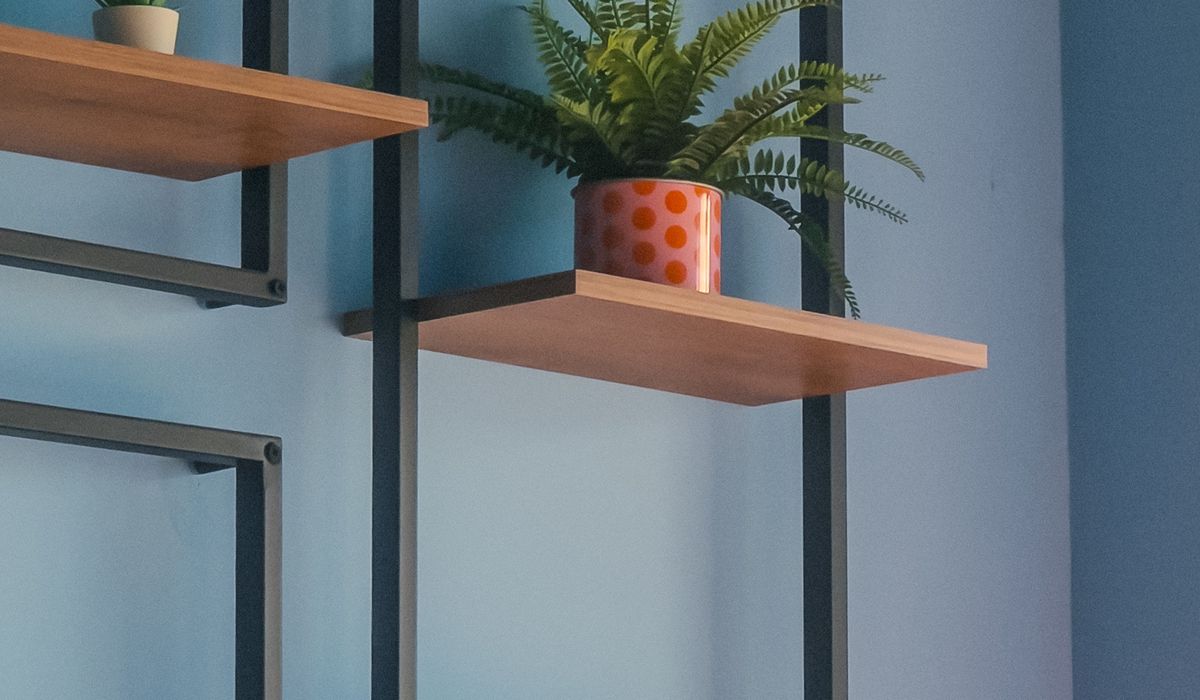
Use the vertical space instead. A narrow shelf above the desk, a small wall pocket, or a set of slim floating drawers will hold stationery and paperwork without eating into your working area. Keep the shelf shallow — around 15–20cm — so it does not feel like it is leaning over you. A pinboard on the side wall is useful for the odd note or appointment card, but keep it sparse; a crowded board adds visual noise rather than reducing it.
Keep It Calm Once It's Set Up
A calm workspace is maintained, not created once. Build a two-minute reset into the end of each working day: close the laptop, tidy the leads back into their clips, return the pen to the pot, and wipe the surface. That single habit does more for the feel of the space than any purchase.
Once a month, take five minutes to clear the drawer, check the cable tray for anything that has worked loose, and remove anything that has migrated onto the desk. If the corner starts to feel cramped again, the answer is almost always that something has crept in that does not belong there. Treat the space as deliberately small, and it will keep feeling orderly, warm, and genuinely pleasant to sit at.


Decluttering
-
Break chores into short daily tasks and one deeper weekend session, so rooms stay presentable without consuming entire evenings.


Small Gardens



-

Long established fact that a reader will be distracted
-

Long established fact that a reader will be distracted
-

Long established fact that a reader will be distracted



Storage Ideas
Karla Gleichauf
12 May 2017 at 05:28 pm
On the other hand, we denounce with righteous indignation and dislike men who are so beguiled and demoralized by the charms of pleasure of the moment
M Shyamalan
12 May 2017 at 05:28 pm
On the other hand, we denounce with righteous indignation and dislike men who are so beguiled and demoralized by the charms of pleasure of the moment
Liz Montano
12 May 2017 at 05:28 pm
On the other hand, we denounce with righteous indignation and dislike men who are so beguiled and demoralized by the charms of pleasure of the moment